Historical Cycle and Modern Crises (2) Democratic Decay of Western Civilization
China is undergoing democratization and Islam, secularization. In addition, there is one more transition that's taking place in the modern world within the industrialized democratic states, which is shown in orange below.
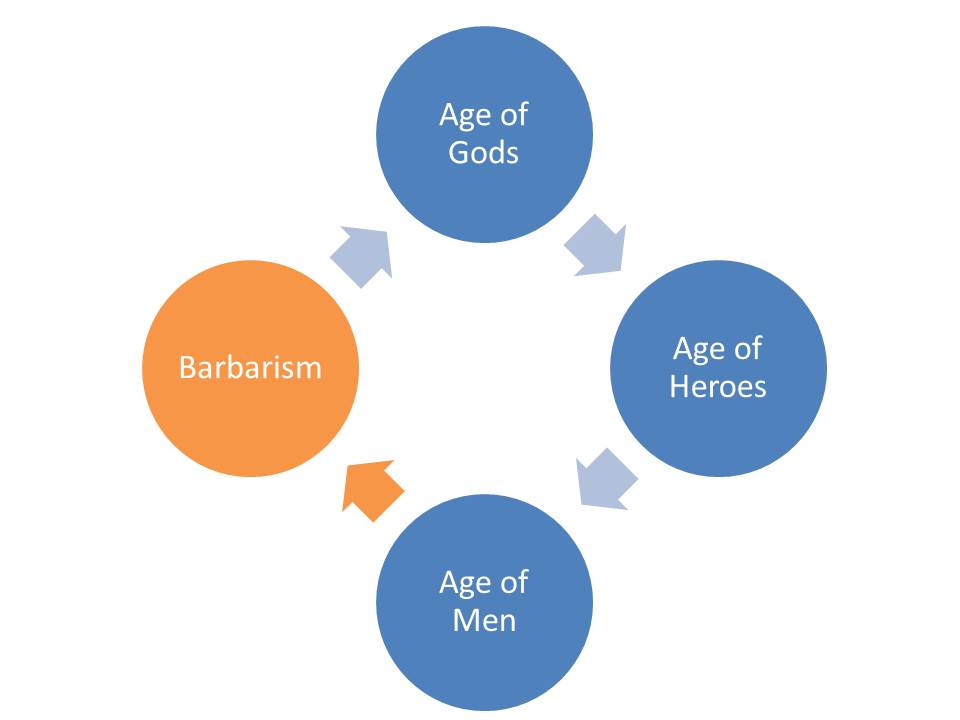
These countries are at the point of democratic decay, which ancient Athens experienced. Does that mean that the decay is unavoidable in modern democracy?
(1) The Difference in Democratic System between Modern Society and Ancient Athens
A quick look may make us believe that ancient Athens and modern democracies are completely different. For example, Athens adopted direct democracy, while modern states are indirect democracies. Then, can we say that the lessons from ancient Athens are not applicable to modern society, and that our democracies will last forever? Before we reach any conclusions, let's examine the issue a little more closely.
First, our democracies are much larger in size, compared to ancient Athens, and, therefore, the system is much more complex. The separation of power among the legislative, administrative and judicial branches in government is established. Added to that is the system of check and balance among these three blanches to avoid the abuse of power. Now, then, is it enough for modern democracy to avoid the fate of ancient Athens? When we think about it, doesn't checking each other mean to expose how others are not doing what they are supposed to do? Then, can it mean that people can do anything as long as they are not caught? The corrupt form of this practice seems to be negative campaigns. Politicians expose illegal or unethical conducts of their opponents in order to win the election. As a result, voters come to believe that all politicians are crooks, which discredit not only individual politicians but eventually the political system itself, shaking the foundation for democracy. Are we to be happy that the system of check and balance is at work this way? Or, should we want to have leaders with integrity not to resort to dirty measures to be elected to begin with? In order to create a stable and lasting society, won't it be necessary to establish a social system in which each citizen has a strong sense of responsibility to do his or her duty whether or not others are watching? Is there any way to reform the current system for this goal?
It will be good if we can find the way to overcome the problems Athens faced by reforming the political system. But if it is difficult, we must start looking at the possibility that there may be defects in the democratic principle itself. If that is the case, democratic decay will still be unavoidable.
(2) Problems in Fundamental Democratic Principles
According to Vico's cycle, democracy comes as the reaction to dictatorship, so it tries to establish a stable and peaceful society by overcoming the problems experienced under dictatorship. In the old regime, human rights were severely violated. People were not even allowed to have their own faith. To avoid this, democracy gives sovereign to people. Also, the notion of duty, which was abused by dictators, is de-emphasized, while that of right is emphasized. As the reaction to the age when even a slightest criticism against the ruler led to a severe punishment, the notion of freedom is also emphasized. Finally, as the reaction to class society, ruled by the privileged, equality is considered as a very important principle. These were adopted as a result of the lessons learned from the immediately preceding historical era. But when these solutions are examined from a larger historical view, can we say that they are adequate? Let's look at this point more closely here.
The Principle of Popular Sovereignty and Its Problem
First, regarding the fundamental democratic principle of popular sovereignty, is it a functional principle in real society? Sovereigns hold the ultimate responsibility for everything that happens in society. Let's take a business organization as an example, the president takes the responsibility and often resigns if there is a problem. What if, then, everyone in the company becomes president? When there is a problem, they all share the responsibility equally. Does that mean that everyone must resign? Or, when the responsibility is equally divided, each share becomes too small for anyone to do anything. Does that mean that no one takes responsibility in the end? Can such a company train a responsible management team and function efficiently? Here, the state is much larger in size. If there is a problem in a democratic country, millions of people share the responsibility. People often say that politicians are to blame, but will it be the same as the president blaming his subordinates for not earning enough profits? If his workers are not up to the job, it will be the responsibility of the president to select competent workers and train them well. In a democratic country, millions of people must responsibly perform this task, but is it realistic? How, then, can democratic sovereigns solve this problem?
Emphasis on Rights and Its Problem
Next, in democracy, the notion of right is excessively emphasized and that of duty is neglected for the protection of human rights. Here, let's understand that the right is to place priority on defending the interest of each individual, and the duty, on defending the interest of society as a whole. These two are not necessarily contradictory. In an ideal situation, where each citizen performs his or her assigned duty diligently, society will become stable and safe, providing the environment in which citizens can benefit to live safely and peacefully. In this virtuous circle, performing duty should eventually help the performers. However, in dictatorship, rulers who pursue only their own interests use their people as tools for their private gains by threatening or lying people that it would be for the whole society. So, democracy eliminated this abused notion of duty. From this, we should conclude that democracy is a society in which people who have strong sense of right and no sense of duty are ruling as the sovereign. Then, does it look like we are in a vicious circle? In a society filled with people who pursue only their own interests, competitions would become harsh, leading people to think that hurting others is a necessary evil in order to protect themselves. As this vicious circle repeats, competitions would become even harsher, eventually leading the society to what Thomas Hobbes described as "the war of all against all" Isn't this exactly Vico's Barbarism?
The Principle of Freedom and Its Problem
Next, let's think about the notion of freedom. In dictatorship, criticizing the ruler is not allowed at all. Pursuing a religion or study that the ruler does not believe is also prohibited. In other words, the will of the ruler is imposed on people. As a solution to this problem, democracy places a significant emphasis on the principle of freedom. Them, what is freedom at all? Initially, it was the right of individuals to have their own faith, or to criticize the government. It should not mean that each citizen can do whatever he or she wants to do no matter what consequences it may bring. If citizens interpret freedom in this manner, society will be put in total disarray. Therefore, it is crucial that citizens understand the true meaning of freedom. Freedom, in fact, is the right to regulate ourselves. In other words, instead of being regulated by others, we should be allowed to regulate ourselves. In a free society, there are things we can do and cannot do. The issue about freedom is who decides this. If each citizen is allowed to decide for him or herself, it is democracy, and if the ruler decides for their citizens, it is autocracy. In an ideal situation, either should bring the same result, because the ruler and the citizens alike first would think about the good of all, and then think about what should be allowed and what not within this framework. However, in a society in which rights are excessively emphasized vis-a-vis duties, what will happen if this decision is entrusted to individual citizens? Will the notion of freedom, accompanied with a strong sense of rights, create a competitive society without any rules? In a perfectly free society without any rules, everyone will insist on his or her rights against one another; as a result, the conflict of interest will frequent, dividing the society into winners and losers. Here, modern society coexists with capitalism. In this society, the middle-class is now shrinking, dividing it into the wealthy and the poor. In the capitalist free competition, the strong become stronger and the weak, weaker. Here, also the final point would be the world characterized as survival of the fittest, or Vico's Barbarism.
The Principle of Equality and Its Problem
Finally, let's look at the fundamental democratic principle of equality. This is a notion unique in democracy. In Vico's Ages of Gods and Heroes, there are two classes: the ruling and the ruled. In an ideal society, the ruler will make the most beneficial decisions for all his or her people, and will assign duties suitable to each citizen, who will perform their duties diligently to create a safe and prosperous society, leading a virtuous circle. For this goal, the ruler must be prepared to make the biggest sacrifice, and therefore, must receive the mental and spiritual training to become suited for the ruling responsibility. Plato, an ancient Greek philosopher, made a proposal to identify and train candidates to be "the philosopher king." In it, what Plato emphasizes most is the development of character with integrity not to give in temptations to abuse the designated authority for personal gains. However, again in dictatorship, rulers pursuing individual gains used the class system to secure their dominance by establishing a fixed class system. As a reaction to this, democracy eliminated the ruling class. So, democracy is a system in which the ruled without adequate skills are left alone to govern. In such a society, leaders lack intellectual ability to stabilize the society with a long-term prospect, so the society will become disorderly. They, in return, are incapable of presenting any solutions, making the society even more disorderly. Here again, a vicious circle. Here, the emphasis on rights in a free society once again comes in picture. In this society, citizens have a stronger sense of rights than duties, so getting elected becomes a more important goal for politicians than creating a sustainable society, causing social confusion and distrust in politics among citizens; as a result, a vicious circle is generated, eventually leading to anarchy, or Vico's Barbarism.
An excessive sense of equality will also cause people to think that if any one person has something, they all have the right to have it, too. For example, if a very expensive medical treatment is available to rich people, they insist that the government should provide subsidies so every citizen can afford it. Then, the government may eventually go bankrupt. So, under the system of equality, the ruled all seem to share the responsibility.
The below is the summary of the above discussed problems in democracy.
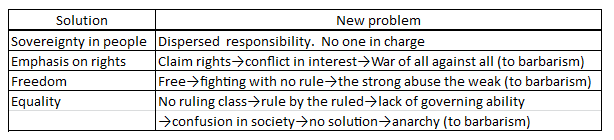
In this way, based on the lessons learned from dictatorship, democracy gives sovereignty to people, emphasizes rights, rather than duties, holds freedom and equality as its fundamental principles. It tries to establish an ideal society in which people can live freely and safely. However, it focuses too much on the problems of the immediately preceding regime, so the pendulum seems to have swung to the opposite extreme. Viewed from the entire cycle of Vico, it seems to lack balance. This maybe the reason that democracy reverts to Barbarism as the reaction.
(3) Issues for Contemporary Democracy
Democratic decay is not only a domestic problem. When we look at international society, we see new problems caused by democratic states. Leaders are elected every few years by citizens of their country, so democratic countries can behave selfishly and short-sightedly in international society. For example, in the 19th century, England opened its market and provide counter-cyclic lending to prevent a great depression. In a democratic country, it is hard to imagine that national leaders sacrifice the immediate needs of their own citizens to save the international society. This could cause international disorder, and come back, in return, to harm themselves - yet another vicious cycle. This vicious cycle could be accelerated when democratic countries feel cornered and act even more selfishly. Therefore, our international society now is facing triple crises, in which democratic countries in the decaying process must face the problems of China's democratization and Islamic transition.
In this way, democratic decay is an impending problem for individual democratic countries and the world. Citizens of democracy have responsibility to deal with it. Is the transition from Age of Men to Barbarism inevitable? Vico's cycle seems to show that all civilizations must take this course and end, but, at the same time, it also seems that humanity has not yet found the right balance, letting the pendulum swinging between the two extremes. If that is the case, finding the right balance will help us end the tragic cycle. What we need to do first, then, is to stop reacting to the immediately preceding historical period and start examining the cycle in its entirety.
The problems in democracy are to disperse sovereignty too much, and to place too much emphasis on the notions of rights, freedom and equality. This is a reaction to the polar opposite regime, but if democratic decay deepens, as a reaction to this regime, polar opposite solutions may be presented - namely - to give concentrated power to one individual, who would govern and give orders to his or her people to follow blindly. There, freedom would be viewed as hindering to maintain order in society, and, therefore, be eliminated. This would start another cycle of Vico.
Let's examine the current situation that democracy is facing. In Western Europe, there are such threats as the rise of rightest parties against immigrants and Britain's exit from the EU. Can this be interpreted as people losing in the existing system are desperately trying to defend themselves against such elements as immigrants who they see are threatening their bare existence? In the United States, demagogue politicians start to appear in political arena. Can this also be interpreted as the weak are getting dissatisfied with the existing system, which is used by power hungry politicians to gain power? They claim that they will change the system to make it better for the weak, so rather than gathering support for themselves, they may be gathering votes of disapproval against the existing system. Once elected, then, they would have no substantive solutions and further deteriorate the situation, discrediting the government. Then, another power hungry politician will challenge the new status quo with even more radical agenda. Thus the vicious cycle of democratic decay will continue.
So, what do citizens in democratic countries do now? As the sovereign of the state, they must try to find the solution to democratic decay. The first thing to do is to recognize the duties as the sovereign, and think seriously about what it means to have sovereignty, what rights, duties, and freedom mean to them. Then, as the president of a company must find and train competent workers for his company, citizens of a democratic country must find the way to recruit and train competent leaders. Just like doctors who are to save lives must be trained for years and get certified, politicians who have significant influence over millions of lives must be trained and get certified. Isn't it irresponsible to let singers and actors occupy political positions? We never let such people operate on us. Also, these days, negative campaigns are becoming usual tactics in elections. Then, how can these people be chosen and be trained? These are some of the things to think about.