Historical Cycle and Modern Crises (2) Islamic Terrorism
Vico's cycle observed in Western World History also exhibits in Islamic civilization. Currently, Islam can be interpreted as transitioning from Age of Gods to Age of Heroes, shown in orange below.
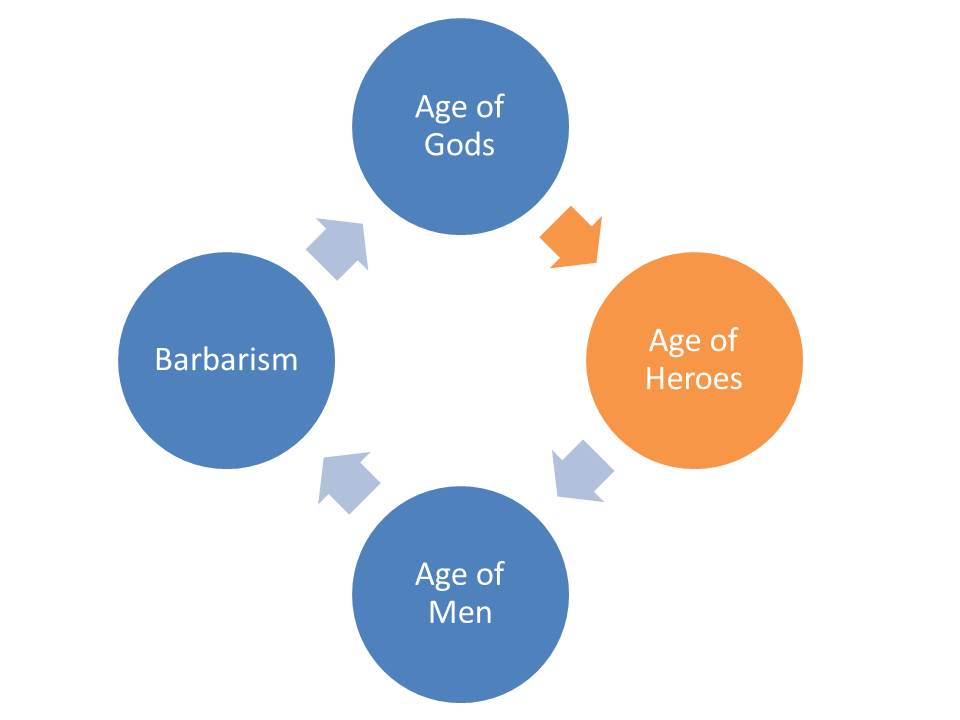
However, the process has been distorted by Western civilization, which is moving ahead in the cycle.
(1) Vico's Cycle in Islamic Civilization
Foundation Period
Islam was established by Muhammad ibn Abdullah in 610. He received revelations from God, which were collected in the Quran. He spread the religion in Mecca, but was met with hostility. In 622, he had to flee to Medina. Unlike with Christianity, Muhammad did not need physical protection from the king because he was capable of both being the Prophet and the protector of the faith. By the end of his life, he was able to consolidate most of the tribes in Arabia. After his death, his combined religious and political authorities became the caliphate, and his successors were called caliphs. The first caliphs were Abu Bakr, Umar, Uthman, and Ali. They were called Rashidun caliphs, who would be nostalgically recalled by later Muslims. In 656, when Uthman was murdered, a succession dispute erupted. Ali, a cousin of Muhammad, was chosen to be the next caliph. But Muawiyah—the governor of Syria—and others contested, and civil war broke out. After Ali’s death, Muawiyah became the caliph and founded the Umayyad dynasty, which lasted until 750. This dispute eventually evolved into the division of Islam between Sunnis and Shias. When internal disarray caused the demise of the dynasty, it was succeeded by the Abbasid dynasty, which lasted until 1258. The period between 750 and 945 was called the high caliphate of the Abbasid Empire. The Abbasid became an absolute monarch as both secular king and spiritual leader of the Islamic ummah (community). After 945, the Abbasid Empire started to decline. In 945, the Abbasid dynasty was taken over by an Iranian military dynasty. The caliphate lost substantive power and became a mere figurehead. Its fragmentation continued until its demise in 1258. During this period, they compiled the Islamic law, which is called the shariah.
Three Empires
The Abbasid Empire was eventually replaced with three major regional empires—the Ottoman, Safavid and Mughal. The Ottoman Empire was an absolute monarch, which was ruled by the sultan-caliph. It had three ruling elites—the military, the civil service and the religious authority called ulama, qadis (judges) and shaykh al-Islam (chief religious dignitary). They were Sunnis. But at this point, the religious influence was put under secular authority. During the 16th and 17th centuries, the Ottoman Empire lost its dominance, but the empire lasted until the end of World War I. The Safavid Empire was located in modern Iran, and lasted from 1501 to 1722.The founder of the empire, Shah Ismail, adopted Shiism and created a strong religious influence. It was initially a tribal military regime, but it transformed itself into an absolutist, bureaucratic empire in the 16th century. It completed the centralization of the government during the reign of Shah Abbas I (1527–1629). The Sunni Ottoman and Shia Safavid fought over Iraq. In 1508 Shah Ismail occupied Baghdad. While occupying Baghdad, the Safavid Empire imposed Shiism on the population. The Ottoman Empire, as the protector of Sunni Islam, could not tolerate it, especially in the very place that used to be the center of the Abbasid caliphate. In 1534, the Ottoman ruler restored Iraq under Ottoman control, claiming successfully to be the supreme ruler of the Islamic world. But it was taken back by Shah Abbas in 1624, only to be taken back by Ottoman’s Murat IV in 1638.
India started to feel an Islamic presence during the 7th century. Islam’s spread was helped by Sufism because its similarity to Hinduism made it easy for Hindu followers to practice. Islam attempted to invade India under the Umayyad Dynasty, and at the end of the 12th century, the Delhi Sultanate was established. The Delhi Sultanate was absorbed by the Mughal Empire when it was established in 1526. Initially, it tried to be independent of orthodox Islam by declaring an independent caliphate within its domain; however, in the end, it accepted the orthodoxy. The Mughal Empire reached its zenith in the early 18th century, from which time it steadily declined until its final demise in 1862.
Return to Classicism and Western Influence
During the 17th century, a reform movement began in Islamic India. Then in the 18th century, in central Arabia, a puritanical reform movement called Wahhabism began. More reform movements followed. Leaders of these movements were educated through the tradition of classic Islam, and came to believe that the corrupt secular practices permeated Islamic society, which, as a result, deviated from the tradition of the Prophet. They emphasized a return to classic Islam.
In the 19th century, Islamic modernists engaged in a reform movement. Unlike in Western civilization, which went through the natural process from the Reformation and Counter Reformation, followed by the Enlightenment as a path to modernity, Islamic civilization proceeded under Western imperialism, which distorted the process. First, the Islamic modernists tried to implement the Western institutions in order to free them from domination by the West. However, they were unable to import institutions alien to their cultural and spiritual foundation. As a reaction to this problem, the Islamic society experienced a resurgence of fundamentalism.
Entering the 20th century, the Ottoman Empire collapsed, and the Islamic civilization was more deeply incorporated into the Western international political system. The Ottoman territories were divided and eventually became occupied with the sovereign states. The fact that the nation-state format was imposed before secularization proceeded at its own pace implanted the seeds of fundamentalism. In addition, it complicated the modernization process in terms of the number of existing social groups. In the West, by the time industrialization created bourgeoisie and labor, the religious authority had lost its political influence. Democratization proceeded in the presence of four social groups at most: King, Aristocracy, Bourgeoisie and Labor. We have seen that the more social groups the process involves, the more complicated it becomes. The Islamic states now have one more, the religious social group, which also can be divided, totaling five or more. This complicates the process more than that in the West.
The effects across Islam are not identical. Turkey succeeded in secularization immediately. The sultanate was eliminated in 1922 and the caliphate was abolished in 1924. Turkey then proceeded with democratization in a similar manner to the secular Western states. On the other end of the spectrum, Saudi Arabia became a kingdom. The monarch is deeply rooted in the region, gaining its legitimacy from the Islamic foundations. Some states are going through industrialization and democratization under a strong religious influence. In Iran, Mosaddiq formed the National Front against the Shah with a coalition of religious and secular supporters but failed. Eventually Ayatollah Khomeini established a highly reactionary religious regime. In Egypt, young military officers launched a coup d’état and abolished the monarch in the 1950s. Unlike Iran, the coup against the monarch was a power struggle between two military social groups, not between the military and economic social groups. The religious influence had been expressed in the form of the Muslim Brotherhood but, the military regime pushed them underground and used religion as a tool to secure its dominance. In Syria and Iraq, the old ruling class was defeated by a military coup d’état by officers in rural origins. In the end, Hefiz al-Asad in Syria and Saddam Hussein in Iraq consolidated power and became dictators. They relied on the ideology of the Baath, which is fundamentally secular with some Islamic elements. This made it unnecessary for them to rely on Islam, so the traditional religious social groups were excluded. But the Baathist ideology failed to cultivate the universal acceptance among the population. So, al-Asad and Hussein had to adopt more repressive measures.
Where do these differences come from? Possibly they come from such factors as the geopolitical situation of each county, the existence or lack of oil reserve, the level of industrialization, the availability of alternative ideologies, and the international environment and foreign influence. Further detailed research will be necessary to reach a definite conclusion.
(2) Issues for Islam in the 21st Century
In this way, the process in Islamic civilization was distorted by Western imperialism, and democratization was initiated before power balance between the religious and military authorities had been settled. Further, during the 1980s and 1990s, some countries succeeded modernization; as a result, the socio-economic conditions started to challenge their old political system. Furthermore, the end of the Cold War drastically altered their environment. These changes greatly affected their secularization process. In the early 21st century, the Islamic world has entered an era of uncertainty. How do these situations affect international society?
Strong Religious Influence
Power contenders in Islam in the 21st century still have religious options, which have potential for fundamentalism. In addition, they also have secular nationalism as an option, which can be expanded to be Arabism. Their religious options provide the possibility for uniting the region, while their secular options tend to divide them. Both options have been tried. In Iran, Ayatollah Khomeini adopted religious fundamentalism against the Shah regime. Most recently, such organizations as the Taliban are trying to appeal to people beyond their national borders by appealing to Islamic values. These movements have been so far relatively isolated and failed to become a global trend. The global appeal that the religion provides is not useful for the power contenders fighting their regional rivals. For example, the Middle East suffers division between the oil-producing and nonoil-producing countries. Some countries also compete for regional dominance. Which option they choose would decide whether Islamic countries unite against the West or fight among themselves. In fact, After the Iranian revolution of 1979, under the leadership of Ayatollah Ruhollah Khomeini, Iran called for the restoration of Islamic institutions. However, this time, Islamic countries were not responsive. According to a specialist's analysis, the revolutionary success encouraged Islamic people who were disenchanted with Western developmental models and wanted a restoration of Islamic institutions. But the rulers of the Middle East did not feel the same way. Iran’s militant Islamic Republic shook conservative monarchs and reformist dictators, isolating Iran. (William L. Cleveland, A History of the Modern Middle East, Boulder: Westview Press, 1994, p.398).
So, this is not an easy task to accomplish. However, if the Islamic states ever successfully adopted the common enemy strategy to achieve its internal unity and export violence outside its own sphere, they might be able to avoid the devastating war within, but violence could spread globally. The world would become extremely unstable. Depending on the availability, it might form an alliance with democratizing China against the Western industrialized states, or indiscriminately export violence anywhere into non-Islamic region in the form of Jihad. Islamic militants are now spreading their messages through the internet, and have achieved some tactical successes. Young adults who hold grievances against the existing system are responding, randomly attacking the establishment. Whether or not this can become a global phenomenon, enough to threaten the existing system, is yet to be seen, but if it follows a wrong direction, it can become a serious threat to international society.
Lack of Foundation for Democracy
The second problem we need to focus on is the wisdom of forcing democracy to regions which are not yet ready for it. As mentioned in Lecture 2, democratization in the modern world becomes possible only after industrialization proceeds deep enough to produce bourgeoisie and labor, capable of taking over the political power from the old military classes. It will be difficult for societies without such foundation to achieve democracy even if the West imposes the democratic system on them. China and Russia in the 20th century failed to democratize and reverted to another form of dictatorship because they didn't have strong economic social groups.
The Islamic world seems to be reverting to Barbarism. For example, in Syria, there was a rebel against the dictator, Al-Asad, which developed to a civil war. According to Henry Kissinger, a famous diplomat in the 20th century, to the principal Syrian and local leaders the war was not about democracy but about gaining power. They were interested in democracy only if it put them in power, but did not support any system in which they could not be in control. They believed that the issue was not between dictatorship and democracy, but between contending parties in Syria and their local supporters. They perceived that the war was about who would gain a domination and rule Syria. The battle became deadlocked and brutal. There, no one cared about human rights, looking nothing like a democratic reign.(Henry Kissinger, World Order, New York: Penguin Press, 2014, p.126)
In this way, in Middle East, the state system broke down and power struggle among military groups ensued. The region where states used to govern is experiencing power vacuum and reverting to Vico's Barbarism. In the areas where the central government has already collapsed, power contenders are fighting hard, sacrificing local residents. Even in the areas where some state functions remain, leaders tighten their rules, stating the threat surrounding them as a reason. Each military leader competes for support from outside, such as the United States and Russia. The religious influence remains strong and is still available to power contenders as a tool, so many conflicts can take a shape of religious struggle such as a holy war against the "corrupt" West.