Historical Cycle and Modern Crises (1) Rise of China
When we look at international society, we see that China is going through democratization now, which is shown in orange in the diagram below.
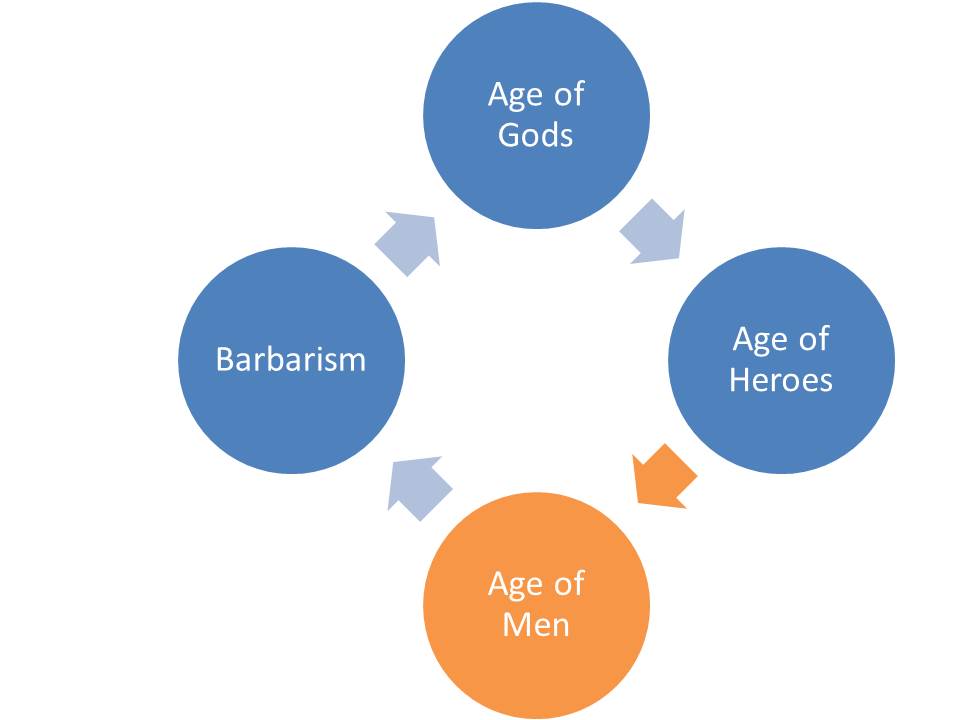
In Western World History, some democratization processes were completed peacefully, while others experienced internal violence. Among others, Germany and Italy adopted expansionism, eventually leading to World War II, which was the biggest tragedy in history. If China follows this course, it will be devastating for international society. What contribution can history make to deal with this problem?
(1) The Formation of Expansionist State - Germany
Here, let's look at German history as an example of democratization ending with expansionism. The German states rapidly proceeded with industrialization during the 1840s and 1850s. A united Germany was formed in 1871. The distribution of power was institutionalized in the Reichstag. The kaiser was the sovereign, and the aristocracy and the bourgeois interests were represented in the Reichstag. Labor began to be important politically but was given very limited representation in the Reichstag.
In international society, Germany was in a position to catch up with Great Britain both economically and militarily. This caused Germany to develop concentrated bourgeois interests, along with a middle class that consisted of small bourgeoisie. A strong military interest had been present in Germany, but it intensified as Germany tried to develop naval capabilities equivalent to that of Great Britain.
Soon after Germany was united, all four social groups were present in the domestic society. During that period, economic and security circumstances were conducive to radical expansionism. The economic circumstances that had been good during the mid-nineteenth century deteriorated in the 1870s. At the same time, this economic downturn triggered a scramble for imperialism, which resulted in instability in European security. As a result, the German bourgeoisie entered a coalition with the military, which was closely tied to the aristocracy, and pressed for naval expansion as part of Kaiser Wilhelm II’s policy of Weltpolitik. Lacking allies in society, the SPD, a labor party, supported war, hoping to win some welfare concessions in return.
After its defeat in World War I, Germany once again became radical expansionists. The kaiser was gone as a result of the defeat. The military was on the verge of extinction during the revolution in 1918. The SPD, by then a reformist party rather than revolutionary, became the ruling party at the Reichstag. This social group was facing a severe threat from radical labor, which opened its own revolutionary congress and voted to dissolve the traditional military cadet school and to place the supreme command under tight civilian control.
Meanwhile, Germany’s international position had significantly changed. Totally destroyed, Germany had to catch up economically. More importantly, the harsh disarmament terms imposed by the victorious allies caused some radicalization of the military. This was not too severe because the military was badly needed in German domestic society. Facing the imminent threat of labor aggression, the bourgeoisie made a deal with the military through a phone conversation between army official Gröner and SPD leader Ebert, in which the military offered protection of the bourgeoisie from the labor threat in exchange for securing political influence of the military. Germany had been suffering hyperinflation during the 1920s. And the Great Depression hit very hard in Germany.
The economic social groups were in disarray. Against this backdrop, an expansionist coalition formed around the National Socialist Party with all segments of the society participating during the election of March 5, 1933. The army supported Hitler’s rearmament policy. Hitler also made a deal with the army. He eradicated his own paramilitary group, SA, to secure the independence of the army. The army, in return, did not block Hitler’s rise. During the early period of the national socialist history, capitalists, such as von Borsig—a locomotive manufacturer and the leading industrialist in Germany—funded the party. In 1932–1933, when the party faced financial difficulties, an influential member of the Steel Trust in Western Germany and other industrialists took over most of its debt, responding to the slogan of the party: “If the National Socialist Party collapses, there will be another ten million communists in Germany.” In October 1930, when a wave of strikes spread in Germany, Hitler supported the strike, explaining to the employers that condemning the strike would let their working members go over to Socialism. In March 1933, the general public—many of them must have been workers—supported Hitler’s party, which obtained the most seats in Congress, 288, followed by Social Democrats’ 120.
(2) Lessons Learned from History on the Formation of Expansionist State
From this example, we can formulate the following hypotheses about the formation of expansionist states during democratization
(1) The Necessary Condition: If state-formation and industrialization take place simultaneously or very close to each other, and/or if industrialization is very rapid, there will be multiple social groups in domestic society, which provides the environment susceptible to form social coalitions.
(2) The Interest Formation: The farther back economically the democratizing state is from the industrialized country, the more likely it is to develop a concentrated large bourgeoisie and labor in society. Also, the farther back militarily the democratizing state is from the world powers, the more likely it is to develop a strong military interest in the domestic society.
(3) The Coalition Formation: If the economy is growing during democratization, it is likely that the economic social groups will unite. On the other hand, if the economy is stagnating or shrinking during democratization, it is likely that the economic social groups will fail to form an antimilitary condition.
If there is a war during democratization, the military social groups will have more leverage against the economic social groups; therefore, it is more likely for the military interest to be reflected in the coalition. On the other hand, if it is peaceful, the military interest will be likely to be excluded from the coalition. However, if the military social groups face severe insecurity in domestic society, they will place their survival in domestic society above their survival as a state in international society, leaning to adopt expansionist strategies.
In this way, democratization does not necessarily come with military confrontation, but there is also realistic risk. In fact, in addition to Germany, Italy and Japan, which conducted the state-formation and industrialization during the same period, became expansionists, together forming the Axis Power in World War II.
(3) Lessons for China
Is it possible for us to apply this historical lesson to China's democratization? At first, Germany and China seem two totally different countries. Germany belongs Western civilization in the tradition of Christianity, while China has its own oriental civilization in the tradition of Confucianism. We can find numerous differences like these. However, we must first carefully examine if these differences invalidate the general principles. Take, for example, Akashi-Kaikyo Bridge and the Golden Gate Bridge in San Francisco, there are many differences. The former is in Japan, is white, spans almost 4000m, and does not allow pedestrians to cross. The latter is in the United States, is red, spans less than 3000m and allows pedestrians to cross. But we cannot say that there is nothing for one to learn from the other. They are both suspension bridges. So, a valid argument would be something like: Even if the Golden Gate Bridge falls down, Akashi-Kaikyo Bridge will not, because it uses steel cables twice as strong (this is not a fact.) This is a very important point when we apply historical lessons to contemporary problems. We need to examine carefully which differences affect general principles and which differences are irrelevant.
Let's see China from this viewpoint. It is now rapidly industrializing. It started its democratization from socialism with large state-owned industries. The international environment is uncertain with the nearby existence of Russia and North Korea. On the other hand, while Germany and Japan industrialized through heavy industries, China is in the third industrialization wave, in which such industries as information technology is the main driving force, so a concentrated labor group may not emerge. Take all these factors into consideration, we must first decide if there is indeed a risk for China to become expansionist, and then, if so, how we can change the course to avoid yet another devastating world conflict. In so doing, we must keep in mind that this process historically took 70 to 80 years; therefore, it is crucial to have a long-term perspective, while dealing with immediate issues.