Vico's Cycle in Western World History
In this lecture, let's examine if Vico's cycle applies to Western World History.
(1) From Age of Men to Barbarism - Ancient Greece and Rome
The study of Western World History in high school usually starts with ancient Greece and Rome. The cycles of these two civilizations have been studied by Vico, so here we will start our examination with the transition in Ancient Greece from Age of Men to Barbarism, which is indicated in orange in the diagram below.
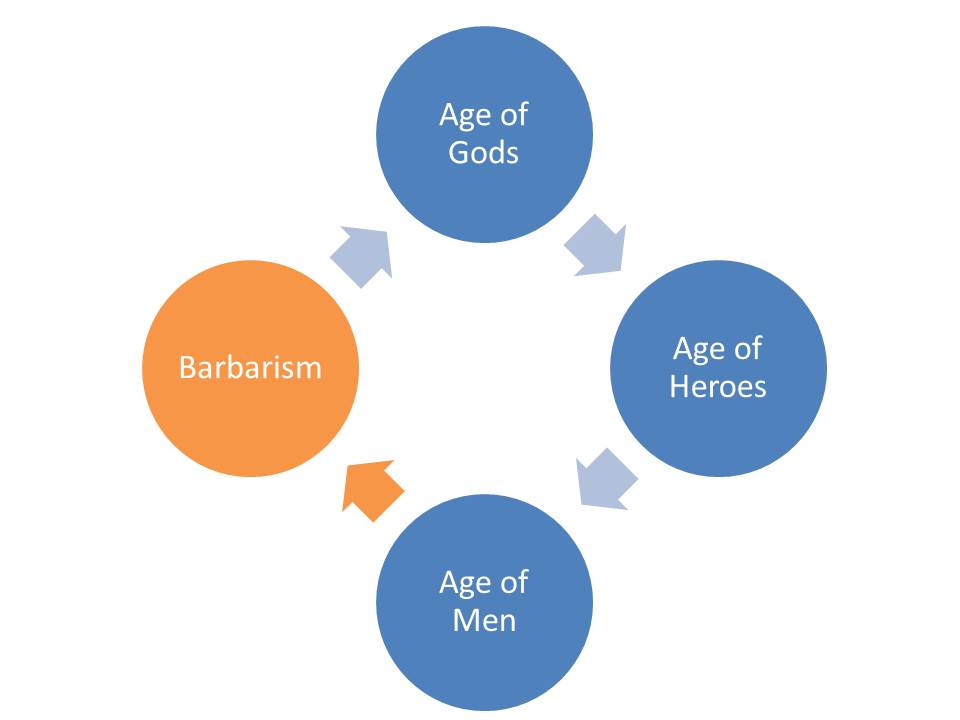
The transition of ancient Athens from Age of Heroes - the rule by aristocrats, to Age of Men - democracy - was marked by the Reforms of Draco and Solon in 621 B.C. and 594 B.C., respectively. It is generally believed that the Reform of Cleisthenes in 508 B.C. established democracy. Athens reached its peak during the age of Pericles in the first half of the fifth century B.C. Here, Athens adopted an imperial policy. Under Pericles, Athens expanded its imperial ambition. Because Athens' naval expansion increased the number of oarsmen, whose political voice had to be heard, democracy expanded. Around this time, however, demagogue politicians started to appear. They did not have any long-term or coherent policies. Their main concern was to obtain and retain power. Toward this goal, they promised anything to please people. People supported war because victory brought more slaves, helping them become richer. As a result, Athens' imperial policy went unchecked. In 431 B.C. the Peloponnesian War broke out and Athens was defeated. Demagogue politics eliminated those who opposed to the tendency, such as Socrates. In the end, it was incorporated under the hegemony of Macedonia, led by Alexander the Great in the mid-fourth century B.C., and then under the Roman Republic.
Ancient Rome also underwent the transition and established the Roman Republic. But in the end, it also lost order and the civil war era started in 133 B.C. In order to regain political stability, the republic designated Caesar as a lifetime dictator. He was assassinated, but his adopted son, Octavius, seized power, ending the Republic. The empire flourished for a while, but it once again became ungovernable in the third century. In the end, it reverted to Barbarism called the Dark Ages.
(2) From Barbarism to Age of Gods -Medieval Europe
Now, let's look at the transition from Barbarism to Age of Gods, shown in orange in the diagram below.
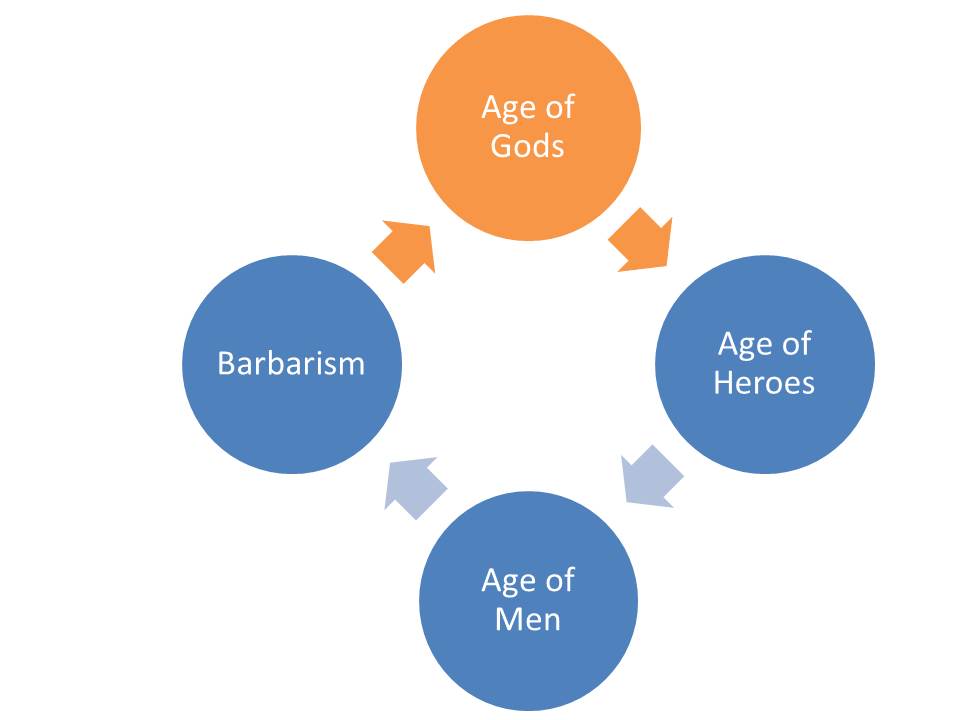
Here, we need to look at the developmental process of Christianity. Christianity came into existence as a reaction to corrupted Judaism. Christians were persecuted in the Roman Empire. The persecution began in 64 in Nero's reign. Its degree and frequency varied depending on the time and place, but it lasted for several hundred years. When the political situation in Rome worsened to the point of near-anarchy, Emperor Constantine legalized Christianity in 313. The unity and monotheism of Christianity served his purpose to reunite the fragmented empire. Then, it continued to develop and in the sixth century, Rome established the superior position in the Catholic Church. It further developed and Pope supremacy peaked during the reign of Pope Innocent III (r: 1198-1216).
Here, let's look at the relation between Emperor, who was the ruler in the secular realm, and Pope, who was the ruler in the spiritual realm. Initially, there was a symbiotic relationship between the two, because Pope needed protection and Emperor wanted legitimacy, by acquiring the recognition by Pope, to be the true emperor among many contenders. In 800, Pope Leo III crowned Emperor Charlemagne as the West Roman emperor. However, their relationship gradually became more competing over power. The diagram below shows this relationship.
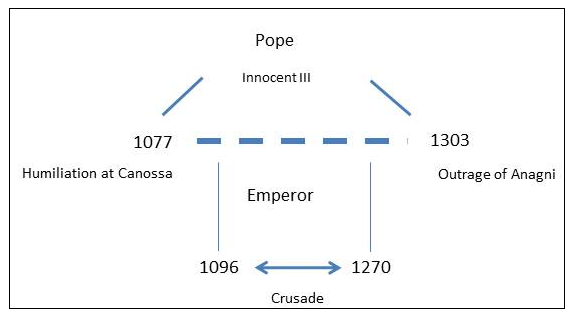
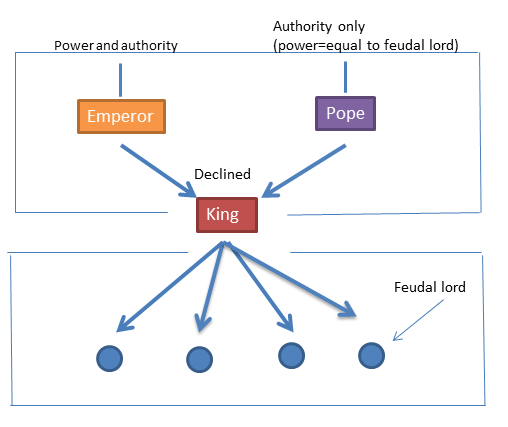
According to this diagram, Pope enjoyed his superior position between the Humiliation at Canossa in 1077, in which an emperor was excommunicated by Gregory VII and the Outrage of Anagni in 1303, in which a pope died in the fight with French king, Phillip IV. Between 1096 and 1270, under the papal leadership, they conducted Crusades. However, the empire gradually declined and new challengers for the secular power emerged. They became centralized states. These are the political units that exist today, such as Great Britain, France and Spain. Their processes of centralization were different, which we do not get into at this time. The overall trend is summarized in the diagram below.
(3) From Age of Gods to Age of Heroes - Formation of Modern International System, populated by States
These states succeeded in further concentration of power, transforming themselves from feudal estates to centralized states. Later, they established standing armies and achieved the rule through coercion. They fought one another, too. The Hundred Years' War between England and France (1339-1543), the Wars of the Roses (1455-1486), and the Italian War (1495-1559) are some examples. At the same time, they took over from Empire the confrontation with Pope. England established its own Anglican Church, trying to gain independence of the Roman Catholic Church.
While secular power was dispersed, spiritual power was also divided. It was the Reformation, which resulted in forming the two churches: Catholic and Protestants. In this way, in Medieval Europe, divided secular and spiritual authorities coexisted, causing severe political disorder. The Thirty Years' War broke out against these backgrounds. It started as a religious war but during the battles, its nature changed. When the war ended with the Peace of Westphalia in 1630, Europe had been transformed into modern society, in which identical political units - the states - populated society with exclusive territories. Spiritual authorities had lost prominence and would become politically less influential. This marked the beginning of Age of Heroes.
(4) From Age of Heroes to Age of Men - Democratization of Western Industrialized States
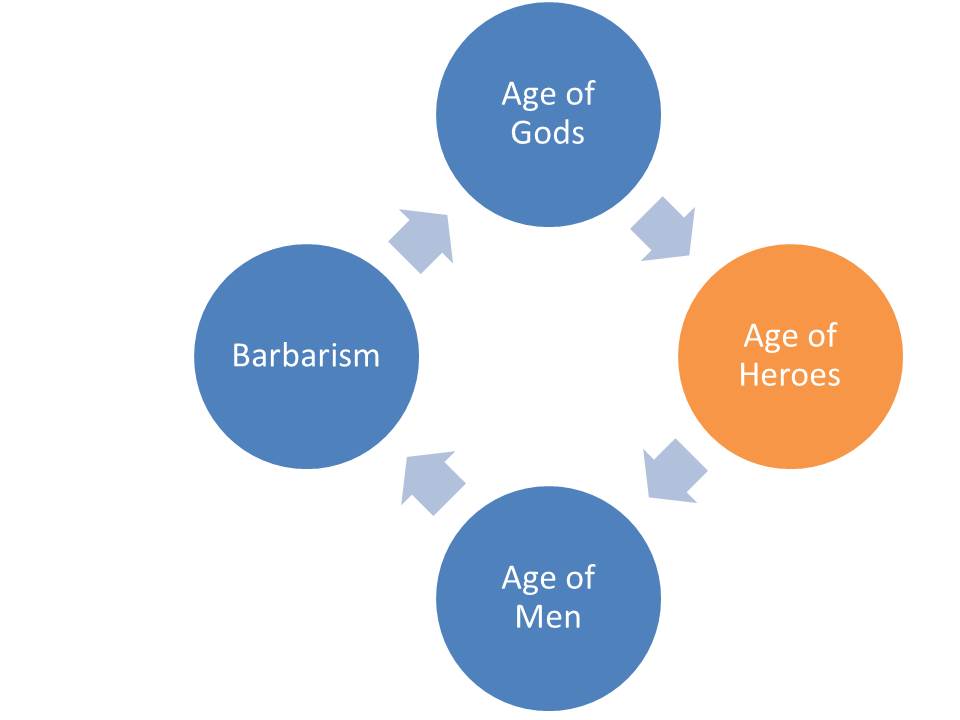
Now, let's look at the transition from Age of Heroes to Age of Men, namely the process of democratization. In centralized states, there was a power struggle between King and Aristocracy - a source of military officers. There, in the 18th century, the Industrial Revolution started, producing new social classes which based their lives on economic activities. They were Bourgeoisie and Labor. Bourgeoisie contended with the military class over political power in order to establish the environment friendly to economic activities. In this aspect, their interest matched with that of Labor. However, they had conflicts over the distribution of economic profits. On the other hand, the competing military classes had common interest to protect the old political system against the rising economic classes. So, these four social groups - King, Aristocracy, Bourgeoisie and Labor - competed and cooperated among one another, with political influence gradually transferred from the military classes to the economic classes. Democratization in modern Western society represents this process, which is shown in orange in the diagram below.
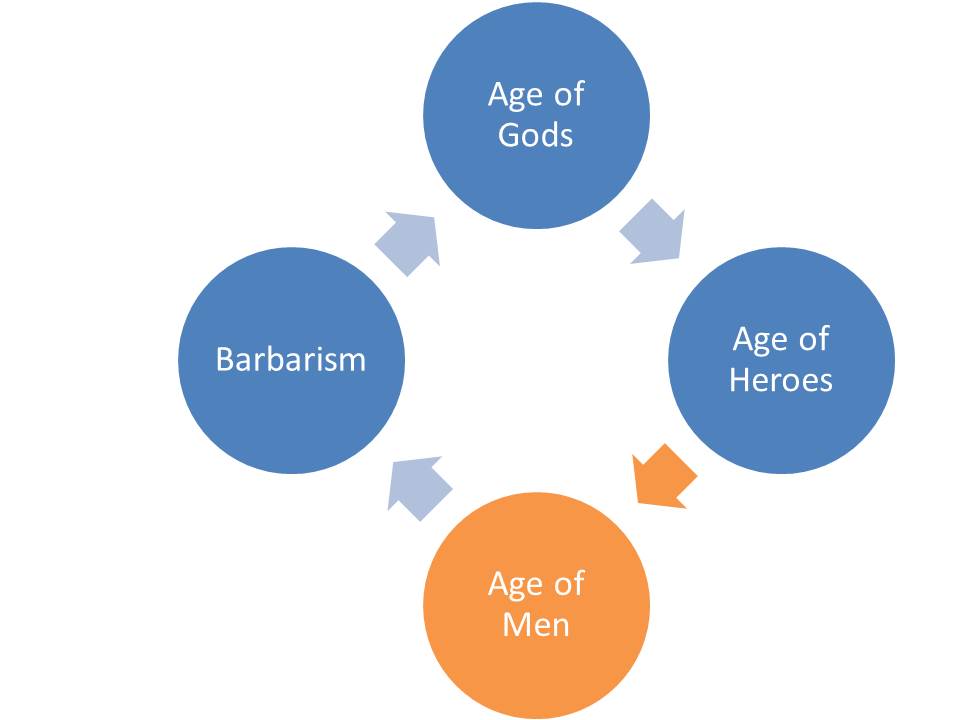
There were great varieties in this transition. Some states achieved democracy relatively peacefully. Others experienced internal violence, such as civil war and revolution, or external violence, such as overseas expansion. Yet others failed to democratize. These variations seem to be due to the different environment, in which they went through democratization. Some of the factors that influence the process are the size of the state, the timing and the speed of industrialization, the economic and military environment, states' historical trajectory and so on. The diagram below summarizes the process. Please click.
In this way, Vico's historical cycle can be applied to Western World History. But what does that mean to us? When we apply it to modern society, we can see that China is undergoing democratization - the transition from Age of Heroes to Age of Men, that Islam is undergoing secularization - the transition from Age of Gods to Age of Heroes, and industrialized democratic states are underdoing democratic decay - the transition from Age of Men to Barbarism. So, there are three transitions taking place simultaneously in our world now. And to make things more serious, the first two transitions in Western World History was marked with disastrous global wars. This indicates that modern international society is now facing extremely difficult problems. In the next lectures, we will examine each problem in an attempt to draw lessons we can learn from history.