Historical Cycle of Giambattista Vico
Fist, let's think about the significance of history.
 .
.
Here is a dot. This describes us without history. We have no idea where we came from and where we are going. But with history, we have trajectories we can examine. It may be like this.

Or, like this.
Once we have this, like Newton's law of inertia, based on where we were from, we can get some idea where we may be heading. If we have been following the blue line below, probably we will be heading in the direction of the blue arrow. If red, then the red arrow.

If the direction we are heading in is not favorable to us, what can we do? We don't want to go in this direction. Instead, can we go in that direction? In the field of physics, if we want to change the direction of a moving object, we will apply some force so that the direction will change in our favor. The diagram below shows it.

Applying this to history, if a historical trajectory suggests that we are heading in a wrong direction, we can apply some force in order to change it. It will be great if it worked. But, if not, what went wrong? Too much force applied? Wrong angle? In these attempts, history is once again helpful. We can find the efforts made by people years and centuries ago. Some worked. Some didn't. We can follow their successful examples. We can examine their failures, try to find out why they failed, and try something different based on our observations. In this way, history is very important to our future.
But wait! Physics and history are two totally different fields, so it is absurd to apply physical principles to history. But there is actually a historian who adopted this method. That's Giambattista Vico.

He analyzed seven ancient civilizations and concluded that there is a cycle in history. The diagram below shows it.
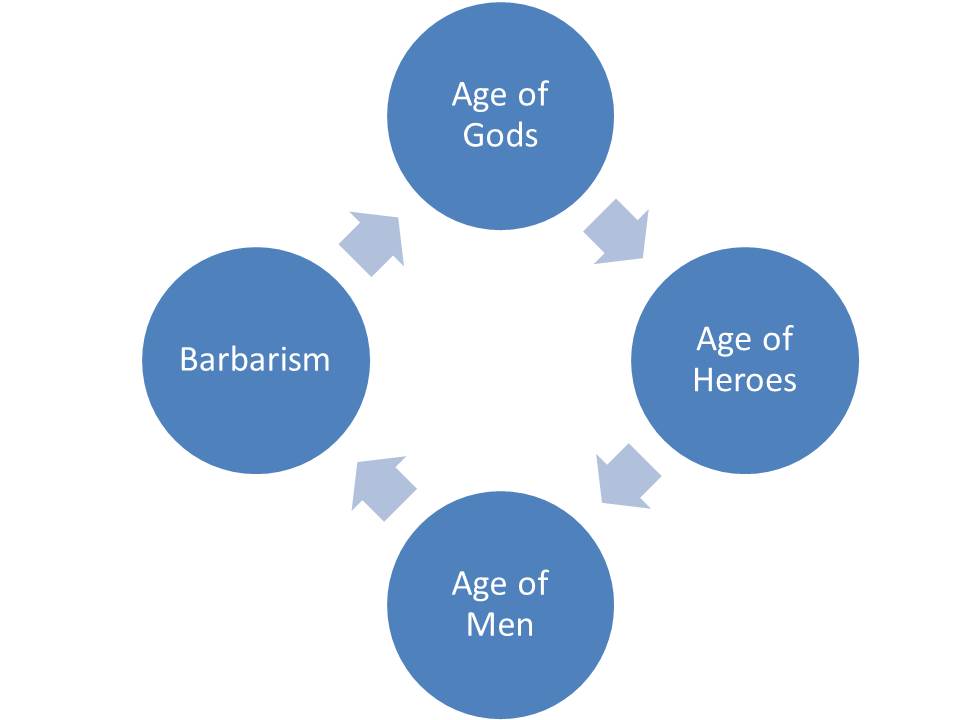
History starts with barbarism. This is what we may call the state of nature, or the world characterized as the survival of the fittest. From there emerges civilization. The first is Age of Gods, in which society is ruled by religious leaders. It will be superseded by Age of Heroes, in which society is ruled by military leaders. Finally, Age of Men - society ruled by people will emerge, only to revert back to Barbarism.
This may be true in the ancient civilizations, but does it apply to Western World History? Let's examine it in Lecture 1.